If you run a dental practice in Austin, you already know the market is crowded. Between Downtown, South Congress, Mueller, and The Domain, there’s a dental office on almost every block.
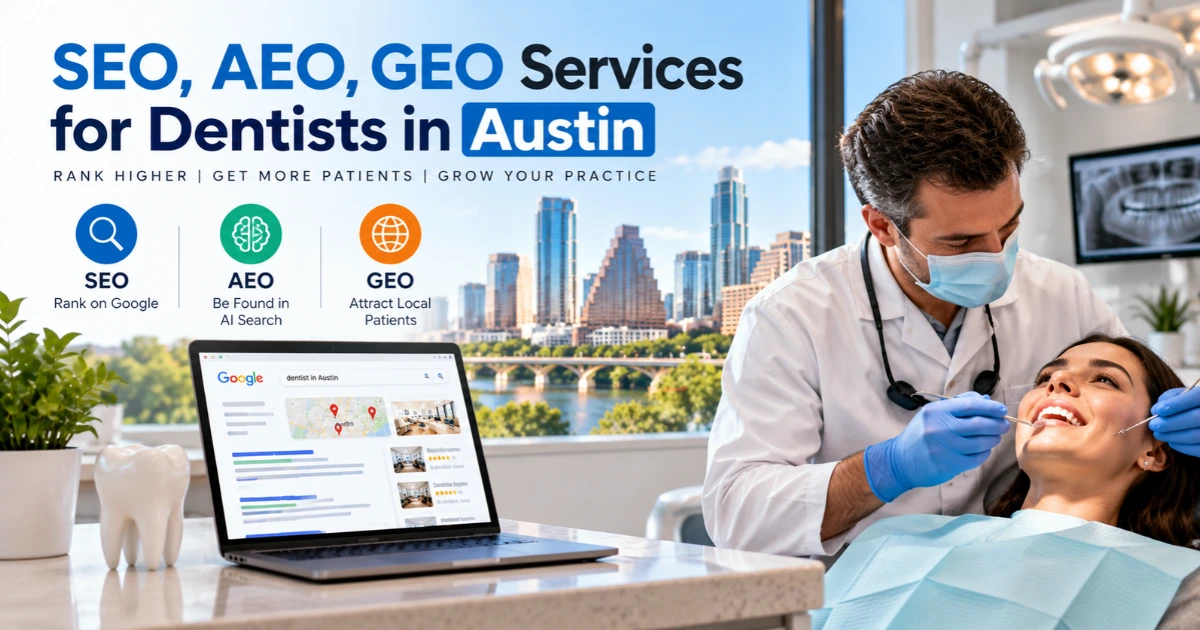
SEO, AEO, GEO services for dentists in Austin exist to solve one problem: the right patient searches, and your clinic isn’t the one that shows up. That search may happen on Google, in a voice command, or inside ChatGPT.
I’m Dhiren, a digital marketing specialist, and this guide shows you how the three channels work together to fill your appointment book.
Why Traditional SEO Alone Isn’t Enough for Austin Dentists
A few years ago, a decent website and a handful of backlinks could put you on page one. That playbook is thinner now.
Patients no longer type “dentist Austin” and scroll through ten blue links. They ask full questions:
- “Who’s the best emergency dentist near The Domain?”
- “Does a dentist in South Congress take my insurance?”
- “How much do Invisalign treatments cost in Austin?”
Google now shows AI-generated summaries above the results. Voice assistants read out a single answer. ChatGPT and Perplexity recommend specific clinics by name.
If your practice isn’t built to be the answer, you’re invisible to a growing share of patients. Ranking is still important, but it’s only the first step.
That’s why SEO services now need to extend into answer and generative search. It’s also why a single “SEO package” from a generic agency often falls short for dental clinics.
SEO, AEO, GEO Services for Dentists in Austin, Explained
These three acronyms get thrown around a lot. Here’s what each one means for a dental practice.
SEO: Getting Found in Search Results
Search Engine Optimization is the foundation. It covers your website structure, service pages, Google Business Profile, reviews, citations, and backlinks.
For a dentist, SEO answers the question: “Does Google trust this clinic enough to show it for ‘family dentist Austin’?”
AEO: Becoming the Direct Answer
Answer Engine Optimization focuses on being the source behind featured snippets, “People Also Ask” boxes, and voice search replies.
It rewards clear, concise, well-structured answers to real patient questions. Think “How long does a dental implant take?” answered in two crisp sentences, followed by detail.
GEO: Being Cited by AI Assistants
Generative Engine Optimization is the newest layer. It helps AI tools like ChatGPT, Perplexity, and Google’s AI Overviews understand, trust, and recommend your clinic.
These systems pull from your website, reviews, directory listings, and mentions across the web. If that information is inconsistent or thin, the AI simply skips you.
Together, SEO, AEO, and GEO services for dentists in Austin cover the full path: being found, being quoted, and being recommended.
Local SEO Foundations Every Austin Dental Clinic Needs
Before chasing AI visibility, lock down the basics. Most clinics I audit are missing at least two of these.
1. A fully built Google Business Profile
Choose accurate categories, list every service, add real photos of your office, and post updates regularly. Answer questions in the Q&A section yourself, before strangers do.
2. Consistent NAP (Name, Address, Phone)
Your details must match everywhere: your site, Yelp, Healthgrades, Zocdoc, and Apple Maps. Even “Suite” vs. “Ste.” can create confusion.
3. Dedicated service pages
One page each for dental implants, Invisalign, emergency dentistry, teeth whitening, pediatric care, and so on. A single “Services” page rarely ranks for anything.
4. A steady review flow
Ask happy patients for reviews right after their visit. Reply to every review, good or bad, in a calm, professional tone.
5. Fast, mobile-friendly website
Most Austin patients find you on a phone, often while commuting on I-35 or MoPac. If your site is slow, they’ll tap the next result.
If you need a rebuild, a freelance website developer who understands SEO from the start will save you costly redesigns later.
For a broader view of the approach, see this guide to local SEO for small business and this one on local SEO for doctors. Both apply directly to dental practices.
How AEO Gets Your Answers Picked by Voice and AI Search
Voice search is conversational and hyper-local. Someone asks their phone, “Where’s a dentist open Saturday near Mueller?” and gets one answer.
To earn that spot, structure your content like this:
- Lead with the answer. Put a direct, 40-to-60-word response right under the question-style heading.
- Use question-based subheadings. Mirror how real patients talk.
- Add FAQ sections. Include them on service pages, not just the blog.
- Use schema markup. Dentist, LocalBusiness, FAQPage, and Review schema help machines read your page correctly.
- Keep hours and services current. Outdated details are an easy reason for an assistant to skip you.
Here’s an example of a snippet-friendly answer:
How long does a dental crown take? Most crowns take two visits about two weeks apart. At the first, we prepare the tooth and place a temporary crown. At the second, we fit the permanent one.
Short, clear, and quotable. That’s what answer engines prefer.
Quality writing carries all of this. Strong content writing services matter because thin, generic copy rarely earns snippets.
GEO: Getting Recommended by ChatGPT, Perplexity, and Google AI
AI tools don’t rank pages the way Google does. They build an answer from sources they consider reliable, then name the businesses that appear credible and relevant.
Here’s what improves your odds.
Build Clear Entity Signals
Make sure the web agrees on who you are. Your clinic name, dentists’ names, credentials, location, and services should read the same across your site, profiles, and directories.
An About page that names your dentists, their training, and their years of practice helps a lot. Don’t hide your team.
Earn Mentions Beyond Your Own Website
AI models learn from the wider web. Local news features, community sponsorships in neighborhoods like South Congress, dental association listings, and reputable directories all act as trust signals.
Publish Original, Experience-Based Content
Generic “5 tips for healthy teeth” posts add nothing. AI systems favor content that shows real expertise: what you see in your chair, how you handle anxious patients, what Austin patients ask most often.
Write for Humans First
Stuffing keywords or writing for robots backfires. Clear, honest, well-organized copy performs well for readers and machines alike.
This is the layer where SEO, AEO, GEO services for dentists in Austin separate real strategy from repackaged old tactics. You can see how this thinking applies to real businesses in the portfolio.
Neighborhood Content That Wins Austin Patients
Austin isn’t one market. It’s a collection of distinct communities, and patients search accordingly.
Consider how different these patient groups are:
- Downtown: Busy professionals who want early, late, or lunch-hour appointments.
- South Congress: Younger, image-conscious patients interested in whitening, aligners, and cosmetic work.
- Mueller: Families looking for gentle pediatric and general dentistry.
- The Domain: Tech workers and relocating residents who often search for new-patient offers and insurance details.
Build location-aware pages and content that speak to each group. Mention landmarks, parking, nearby transit, and typical commute times. Avoid copying the same page and swapping the neighborhood name, because Google spots that quickly.
If you’re curious how this approach looks in other metros, take a look at our work in San Antonio, Nashville, Charlotte, Tampa, Raleigh, Phoenix, Columbus, Indianapolis, and Jacksonville.
Staying Compliant While You Market Your Practice
Healthcare marketing has guardrails, and dentistry is no exception. A great campaign that creates legal headaches isn’t a great campaign.
Keep these points in mind:
- Patient privacy (HIPAA): Never post identifiable patient details, photos, or review responses that confirm someone was a patient.
- Testimonials and before-and-after photos: Get proper written consent, and avoid implying guaranteed results.
- Advertising claims: Avoid unverifiable claims like “best dentist in Austin” unless you can support them. Check the rules from the Texas State Board of Dental Examiners and your professional associations.
- Tracking and forms: Be careful with analytics and ad pixels on pages where patients submit health information.
This isn’t legal advice, so run your final materials past your attorney or compliance advisor. Your marketing partner should still understand these boundaries and build around them. Our privacy policy and terms and conditions show how we handle data responsibly.
Pairing SEO with Paid Ads
SEO builds momentum over months. If you need new patients sooner, paid campaigns can fill gaps while organic rankings grow.
Google Ads capture people actively searching for “emergency dentist near me.” Facebook ads work well for awareness around cosmetic services, Invisalign, and seasonal promotions.
Not sure how to split your budget? This breakdown of Google Ads vs SEO walks through the trade-offs. In most cases, the strongest approach uses both, with SEO reducing your long-term cost per patient.
How to Measure Results
Rankings alone don’t pay your rent. Track the numbers that connect to the schedule.
- Calls and form submissions from your Google Business Profile and website
- Booked appointments by source
- New patient volume for high-value services like implants and clear aligners
- Direction requests and map views
- Branded searches, which show growing recognition
- AI mentions, by regularly testing queries in ChatGPT, Perplexity, and Google AI Overviews.
Expect early improvements in local visibility within a few months. Competitive services and AI citations usually take longer. Anyone promising overnight page-one results isn’t being straight with you.
Working with Dhiren
I’m Dhiren, a digital marketing expert specializing in SEO, AEO, GEO, Google Ads, and Meta Ads. You can read more about my background on the About Us page.
I’ve worked across Business and Professional Services, Food and Hospitality, Beauty and Wellness, Real Estate and Home, Automotive, Home Services, Legal Services, and Healthcare and Medical. That range matters. Legal and medical work, in particular, has taught me how to attract patients and clients while respecting the rules that govern those fields.
For dental clinics, that means a few things:
- Strategy built around your specific services and capacity
- Clear reporting tied to appointments, not vanity metrics
- Content that reflects how your practice actually works
- Compliance-aware messaging
If you want a plan built around your own clinic, book a consultation. Prefer to start with a question? Contact us directly. You can also see the full services overview, or read more on the blog.
Looking for a dedicated offer built just for this market? Visit the Austin dentist SEO page. And if you prefer working with an independent specialist, here’s how a freelancer SEO service in the USA can work.
Conclusion
Austin dental patients are searching in more ways than ever, and the clinics that show up everywhere are the ones that get the calls. SEO, AEO, and GEO services for dentists in Austin give your practice a presence on Google, in voice search, and inside AI assistants.
Start with the foundations, build helpful answers, and keep your information consistent across the web. Then measure what matters: booked appointments.
Ready to fill more chairs? Book your consultation with Dhiren, and let’s build a plan around your clinic.
FAQs
How long do SEO, AEO, GEO services for dentists in Austin take to show results?
Local visibility often improves within three to six months. Competitive keywords and AI citations may take six to twelve months, depending on your starting point and competitors.
Is SEO or Google Ads better for a dental practice?
Neither wins on its own. Ads bring faster leads, while SEO builds lasting, lower-cost visibility. Most practices do best with a blend.
Do I really need AEO and GEO if I rank well on Google?
Yes, increasingly. Patients use voice assistants and AI tools to choose providers, and those tools don’t always follow Google’s rankings. Optimizing for them protects your visibility as search habits shift.
Can I do this myself?
You can handle the basics, like your Google Business Profile and review requests. Technical SEO, schema, content strategy, and AI visibility usually need specialist support.
What does a new-patient-focused strategy include?
Typically a site and Google Business Profile audit, service and neighborhood pages, structured FAQ content, review strategy, citation cleanup, and ongoing reporting.