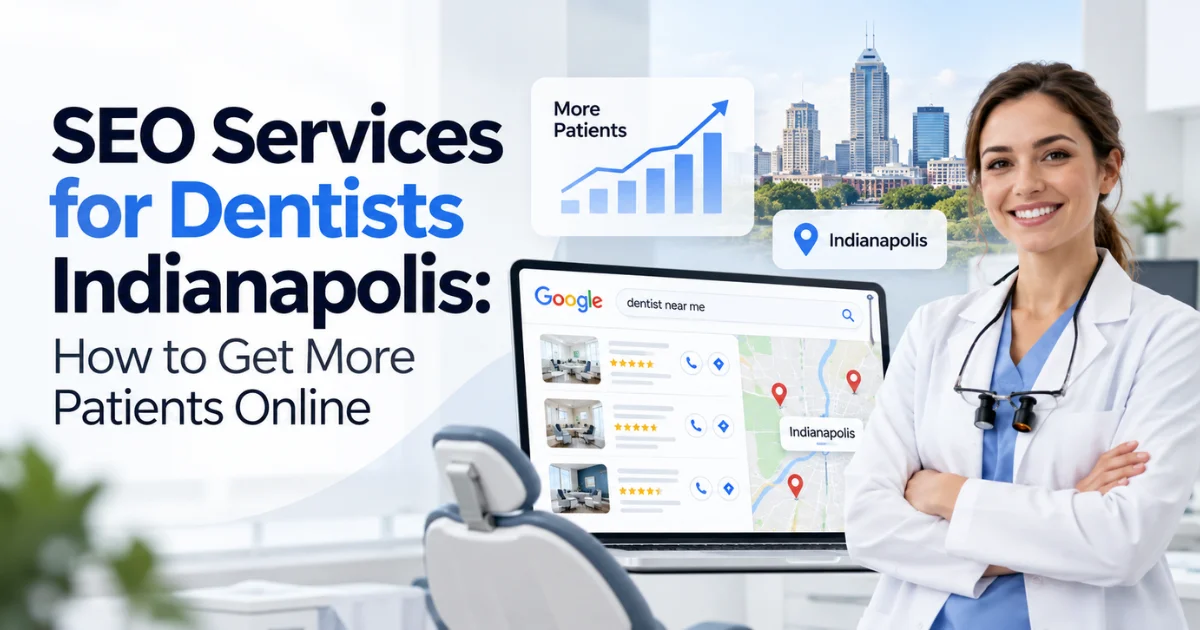
SEO Services for Dentists Indianapolis come down to one test: when someone near Broad Ripple, Castleton, or Southport searches “dentist near me,” does your practice appear? If not, a competitor gets that call.
Local rankings are not a mystery, but they are specific. Google weighs relevance, distance, and prominence, so two offices a few miles apart can see very different results for the same search.
This guide shows what to fix first, how to check where you stand today, and how to tell whether your SEO is producing patients or just traffic.
How Local Search Works for Indianapolis Dental Practices
Indianapolis patients often search by neighborhood, workplace, or commute. Someone downtown may want a dentist near the office. A parent in Castleton may want one near school.
Google’s local results lean on three factors:
- Relevance: how well your profile and pages match the search
- Distance: how close you are to the searcher
- Prominence: your reviews, links, and overall reputation
You can’t change distance, so most of your effort goes into relevance and prominence. That is where good local SEO for dental practices earns its keep.
What SEO Services for Dentists Indianapolis Practices Actually Need
1. Google Business Profile
For many practices, the Google Business Profile (GBP) drives more calls than the website. It is often the first thing a patient sees on a phone.
Check these items:
- Primary category set to “Dentist,” with accurate secondary categories
- Every service listed, such as implants, Invisalign, or emergency visits
- Real photos of your team, office, and entrance
- Correct hours, including holidays
- Name, address, and phone number that match your website exactly
2. One Page Per High-Value Service
A single “Services” page cannot rank for implants, clear aligners, and emergency care at once. Each core service deserves its own page.
Cover who the treatment is for, what the visit involves, how long it takes, and how to book. Add real photos and one clear call to action. If writing is the bottleneck, professional content writing services can help.
3. Local On-Page SEO
Mentioning “Indianapolis” once in the footer is not enough. Strengthen local relevance with:
- Title tags that pair a service with a location
- Landmarks, parking details, and directions patients actually use
- An embedded map and clear service-area language
- Dentist and local business schema markup
The same principles apply across healthcare, as covered in our guide to local SEO for doctors.
4. Reviews
Patients compare your rating and review count with nearby practices before they read your site. Reviews also feed local prominence.
Keep the process simple:
- Ask at checkout by text or email
- Send a direct review link
- Reply to every review without sharing protected health information
- Never offer incentives or filter who gets asked, which violates Google’s policies
5. Citations and Local Links
Consistent directory listings confirm your practice is real. Local links show you belong to the community.
Realistic sources include the chamber of commerce, dental society listings, school or charity sponsorships, and local news features. These take effort, but they build prominence.
6. Technical Health
Many dental searches happen on a phone, sometimes while the patient is in pain. Your site needs fast loading, HTTPS, a working click-to-call button, and easy online booking. A freelance website developer can usually fix these without a full rebuild.
Self-Audit: Check Your Practice in 30 Minutes
Before hiring anyone, answer these questions honestly.
Service pages
- Does every high-value service have its own page?
- Does each page have unique text, not copied from a vendor template?
Google Business Profile
- Is every field accurate and current?
- Do you have recent photos and a steady flow of new reviews?
Tracking
- Are calls from your site and GBP tracked?
- Do appointment form submissions register as conversions?
Search Console
- Which queries show impressions but few clicks?
- Which pages are getting impressions for “near me” and neighborhood searches?
Mobile experience
- Can you book an appointment in under a minute on your phone?
- Is the phone number tappable?
Any “no” is a candidate for your first fix. Start with tracking, since you can’t judge anything else without it.
Neighborhood Strategy: Hypotheses to Test With Your Own Data
Neighborhood-level planning helps, but be careful. The table below shows assumptions to test, not verified patient behavior. Check each against your own top ZIP codes, appointment data, and Search Console queries.
| Area | Possible Patient Need | Hypothesis to Test |
| Downtown / Mass Ave | Workday convenience | Hours, parking, and same-day pages may matter most |
| Broad Ripple | Families and cosmetic interest | Cosmetic and family service pages may convert well |
| Fountain Square | Newer residents | Mobile speed and online booking may carry more weight |
| Castleton | Busy families, many nearby options | Review volume and GBP quality may separate you |
| Southport | Possibly insurance-sensitive | Insurance information pages may reduce friction |
If your data contradicts a row, trust the data. If you run several locations, give each its own location page and GBP listing.
A Hypothetical Example: Evaluating a Campaign
This is an illustration, not a real client result. The numbers are invented to show the method.
Imagine a two-dentist practice on Indianapolis’s north side. Before SEO, they track nothing and have one generic services page.
Here is how they might evaluate a six-month effort:
| Metric | Before | After (illustrative) |
| Implant page impressions (Search Console) | 0 (no page) | Tracked monthly |
| GBP calls per month | Unknown | Tracked via call tracking |
| New-patient inquiries from search | Unknown | Tracked via forms and calls |
| Booked new patients from search | Unknown | Tracked in the practice software |
The point is not the numbers. It is that the practice sets a baseline first, then compares each month against it. Without that baseline, “SEO is working” is just an opinion.
How to Measure Results That Matter
Rankings alone can mislead. A #1 position for a low-value term may bring no appointments. Track these instead:
- Search Console clicks and impressions for service and local queries
- GBP interactions, including calls, direction requests, and website clicks
- Calls and form submissions from the website
- Qualified inquiries and booked appointments
- Marketing cost per new patient, which is total spend divided by new patients acquired
Review these monthly. Over time, patterns show which pages and channels actually fill the schedule.
Dental SEO Services in Indianapolis: DIY, Agency, or Specialist?
| Factor | DIY | General Agency | Dental-Focused Partner |
| Cash cost | Lowest | Moderate to high | Moderate |
| Time cost | High | Low | Low |
| Dental knowledge | Self-taught | Often limited | Stronger |
| Reporting | Whatever you track | Sometimes traffic only | Calls and booked patients |
DIY can work if you have time. Most practice owners are better used chair-side.
If you want senior attention without agency overhead, consider a freelance SEO expert. You can also see our overall SEO services.
Before you hire anyone:
- Be skeptical of guaranteed #1 rankings
- Ask what you will receive each month
- Confirm you own your website, GBP, and data
- Ask for relevant examples, and check our portfolio and about page to see how we work
SEO vs. Google Ads
They do different jobs. Ads can bring patients quickly but stop when the budget stops. SEO builds more slowly and tends to lower your long-term cost per patient.
Many practices use both. Our comparison of Google Ads vs. SEO helps you decide, and our Google Ads services cover the paid side. If budget is tight, fix your GBP and service pages first.
Mistakes That Quietly Cost You Patients
- Inconsistent business information. A different phone number on one directory confuses both patients and Google.
- Unanswered reviews. Patients notice when complaints get ignored.
- One generic services page. It dilutes relevance for every treatment.
- No call tracking. You can’t tell which channel produced a new patient.
- Tracking rankings instead of revenue. Visibility only matters if it leads to appointments.
- Cheap link packages. Low-quality links can invite penalties.
- Stock photos only. Patients want to see the real team.
For a missing-tracking problem, fix tracking first. For weak service pages, prioritize your most profitable treatment. Do not try to fix everything at once.
A 90-Day Roadmap
Days 1–30: Audit and Baseline
- Complete the self-audit above
- Set up call tracking and conversion tracking
- Clean up GBP and directory inconsistencies
- Identify your most valuable services and top patient ZIP codes
Days 31–60: Build and Optimize
- Write or rewrite your top service pages
- Add schema markup and improve internal links
- Launch a simple review request process
- Begin local link outreach
Days 61–90: Expand and Refine
- Publish helpful local content, such as insurance, emergency care, or cosmetic guides
- Add location or neighborhood pages where they genuinely help
- Compare results against your baseline and double down on what works
Timelines vary with competition, your starting point, and consistency. Our guide to local SEO for small business covers more fundamentals, and the blog has related tactics.
Next Steps
Winning in this market is less about tricks and more about being visible, trustworthy, and easy to book. Treat SEO as an ongoing system: set a baseline, fix the biggest gaps, and measure booked appointments.
Want a second opinion? Book a consultation for a review of your Google Business Profile, service pages, and tracking setup, or contact us with questions. You can also explore similar guides, such as dental SEO in Charlotte.
About the Author
I’m Dhiren. I’ve spent years helping businesses across Business/Professional Services, Food & Hospitality, Beauty & Wellness, Real Estate & Home, Automotive, Home Services, Legal Services, Healthcare & Medical and professional services improve their online visibility and attract more customers. Explore more at Client Destination.
How much do SEO Services for Dentists Indianapolis practices typically cost?
Pricing varies widely based on competition, scope, and the number of locations. Be wary of rock-bottom offers, since they usually mean templated work. Ask exactly what deliverables you’re getting each month.
How soon will I see results from local SEO?
GBP and tracking fixes can show changes sooner than competitive service-page rankings. Expect gradual progress, and measure against your baseline.
Should I hire for SEO or run Google Ads first?
If you need patients immediately, ads can help. If you want lasting visibility, start with your GBP and service pages, then add ads for high-value treatments.
Do I need a new website?
Not necessarily. Many practices improve by fixing speed, restructuring service pages, and adding tracking. Rebuild only if the site is outdated or technically broken.
How do I know if my SEO provider is working?
You should see monthly reports covering calls, form submissions, booked appointments, and GBP activity. Rankings and traffic alone are not enough.
Is it risky to ask patients for reviews?
Asking is fine. Offering rewards or screening who you ask is not. Keep requests simple and respond without revealing patient information.