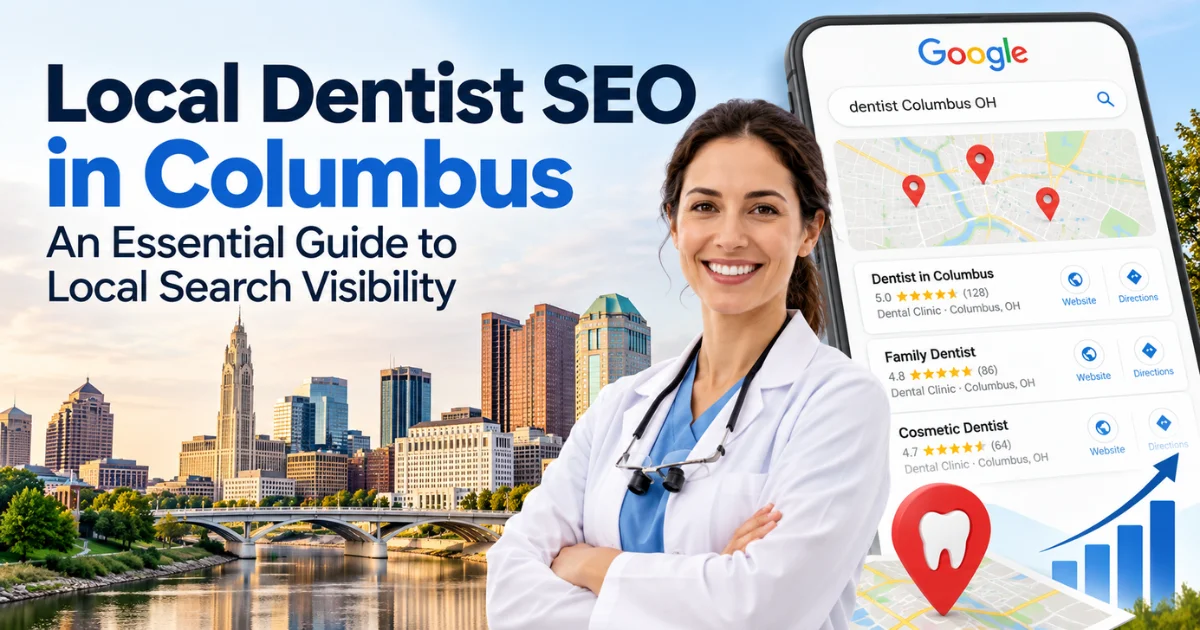
Local Dentist SEO in Columbus comes down to one question: when a patient in your service area searches for a dentist, does your practice show up, or does a competitor three blocks away get the call instead? For most Columbus dental practices, the answer has less to do with clinical quality and more to do with what’s happening (or not happening) with their Google presence.
This guide breaks down what actually helps Columbus dentists rank in the Local Pack, from Short North to Westerville, and how to turn that visibility into booked appointments.
Why Local Dentist SEO in Columbus Matters
Dental care is a near-me search by nature. Nobody drives across town for a routine cleaning when a well-reviewed practice is five minutes away unless Google shows that practice first.
Think with Google research found that 76% of people who search for something nearby on their smartphone visit a related business within a day, and 28% of those searches result in a purchase. For dentists, that “something nearby” search often happens the moment someone has a toothache, a broken crown, or a new insurance plan to use.
That immediacy is why Local Dentist SEO in Columbus is worth treating as an ongoing part of running the practice, not a one-time setup task.
Understanding the Columbus Dental Market
Columbus isn’t one market. It’s a set of distinct neighborhoods, each with different search behavior:
- Short North & German Village — patients who research heavily and read reviews closely before booking
- Clintonville & Grandview Heights — family-dense areas where “family dentist” and “pediatric dentist” searches are common
- Dublin & Westerville — more competition for cosmetic and implant procedures
- Hilliard & Upper Arlington — loyalty-driven patient bases that respond to reputation signals
Treating “Columbus” as one blob instead of these micro-markets is one of the most common gaps we see. Effective Local Dentist SEO in Columbus means optimizing for the specific neighborhoods your practice actually draws patients from, not just the city name.
What the Google Local Pack Is
When someone searches “dentist Columbus OH” or “emergency dentist near me,” Google shows a map with three business listings above the organic results — the Local Pack (or Map 3-Pack). Position matters here: users tend to engage more with the most visible local listings, though exact click behavior varies by query, device, and how the results are laid out.
Google states that local ranking is primarily influenced by three factors:
- Relevance — how well your Business Profile and website match the search intent
- Distance — proximity to the searcher
- Prominence — how well-known your practice is, both online and off
Google doesn’t publish an exact weighting for these three factors — they work together. You can’t control distance, but relevance and prominence are entirely within your reach.
The Core Pillars of Local Dentist SEO in Columbus
1. Google Business Profile Optimization
Your Google Business Profile (GBP) is one of the highest-leverage assets in local dental marketing, and it’s common for practices to set it up once and rarely revisit it.
Do this:
- Choose precise categories (“Cosmetic Dentist,” “Pediatric Dentist,” “Emergency Dental Service”) instead of just “Dentist”
- Upload real photos of your office, team, and Columbus location.
- Post updates regularly (new patient specials, holiday hours, staff spotlights)
- Fill out every attribute Google offers, including insurance accepted and accessibility features.
A complete, accurate profile gives Google more information to match your practice with relevant local searches — and because so many competitors neglect theirs, keeping yours current tends to pay off quickly.
2. Localized On-Page SEO & Neighborhood Pages
Generic “dentist in Columbus” content struggles to compete against practices with genuinely useful, area-specific content. If you serve Bexley or Upper Arlington, don’t just swap the neighborhood name into a template page.
Build pages that explain the services you actually offer to that area, your real service radius, and anything genuinely useful to a patient deciding where to book — not ten near-identical pages with the city name changed. This is the same principle behind our approach to local SEO for doctors, and the fundamentals in our local SEO for small business guide apply here too.
3. Citations & NAP Consistency
Keep your core business information — especially name, address, and phone number — accurate and consistent across your important directories and profiles: Yelp, Healthgrades, Zocdoc, the BBB, and other local listings. Small mismatches, like a missing suite number or an inconsistent “Dr.” prefix, quietly erode Google’s confidence in your listing over time.
4. Reviews & Reputation Management
Reviews directly affect prominence, and Columbus patients—especially cosmetic and implant candidates—read them closely before booking.
A few things that help:
- Ask for reviews at the point of highest satisfaction, not days later by email.
- Aim to respond to reviews promptly, ideally within 48 hours.
- Avoid review gating or selectively asking only satisfied patients to leave reviews — Google’s contributed-content policies prohibit discouraging negative reviews or soliciting only positive ones.
5. Content Marketing & Local Link Building
Content that answers real patient questions (“What does Invisalign cost in Columbus?” or “What to do about a cracked tooth on a weekend”) builds topical authority and gives other sites a reason to link to you. Getting mentioned by local organizations or featured on Columbus news sites builds a backlink profile that’s harder for competitors to copy quickly.
6. Mobile & Website UX
Most local dental searches happen on a phone, often while someone’s in pain and wants an appointment now. A slow site, a buried booking form, or a phone number that isn’t tap-to-call quietly undoes the SEO work you’ve already done.
What a Columbus Dentist Should Audit First
Before building a full strategy, it helps to know where you actually stand. A quick self-audit should look at:
- Your primary and secondary GBP categories
- Whether your service pages match what’s listed on GBP
- Review count, recency, and response rate
- NAP consistency across your top 5–10 directories
- Who’s actually ranking above you in your target neighborhoods?
- Your organic visibility for a handful of core search terms
- How many website visits turn into calls or bookings
This short list usually reveals two or three priorities worth tackling first, rather than trying to fix everything at once.
A 90-Day Local SEO Plan for Columbus Dentists
Month 1 — Foundation
- Full GBP audit and cleanup
- Technical site audit (speed, mobile usability)
- NAP consistency audit across directories
- Keyword and neighborhood mapping
Month 2 — Build-Out
- Service pages aligned to what’s listed on GBP.
- Genuinely useful location/service-area pages (only where warranted)
- Citation cleanup and new citation building
- A repeatable review-request process for front-desk staff
Month 3 and beyond — Growth
- Local link building and community mentions
- Ongoing content addressing real patient questions
- Reputation monitoring and response cadence
- Conversion tracking tied to actual booked appointments, not just rankings
Common Local SEO Mistakes Columbus Dentists Make
- Treating the website and GBP as separate projects instead of one integrated strategy
- Stuffing neighborhood names into content unnaturally, which reads poorly and can look spammy
- Ignoring negative reviews instead of responding professionally
- Duplicate listings from old locations or previous ownership that split ranking signals
- No structured data (schema markup) on the site — schema helps search engines parse what your practice offers, but it supports strong content rather than replacing it
How to Measure Whether Your SEO Is Working
Track outcomes, not just rankings:
- Local Pack impressions and clicks (Google Business Profile Insights)
- Call volume from Google listings
- New patient form submissions
- Website-click-to-booked-appointment conversion rate
- Review velocity — new reviews earned per month
If rankings are improving but new patient calls aren’t, the issue is usually somewhere in the conversion path, not the SEO itself.
DIY vs. Hiring a Local SEO Specialist
Some practice owners manage this in-house, and the framework above is a solid starting point if that’s you. For busy practice owners, though, SEO can easily become a quarterly task rather than an ongoing process, and in a competitive market, that gap is where visibility slips.
It’s also worth understanding paid vs. organic trade-offs before committing budget; our Google Ads vs. SEO breakdown covers when paid ads make sense as a short-term bridge while organic rankings build.
Ready to Improve Your Local Visibility?
I’m Dhiren. I’ve spent over 8 years helping businesses across healthcare, home services, hospitality, and other local service industries improve their online visibility. When I audit a local dental website, I usually look at the Google Business Profile, service pages, local signals, reviews, and conversion path together, rather than treating rankings as the only measure that matters.
If you’d like a straightforward look at where your Columbus practice is losing visibility, book a consultation or get in touch.
FAQ
How long does local dentist SEO take to show results in Columbus?
Most practices see GBP visibility movement within 60–90 days, with stronger Local Pack rankings typically building over 4–6 months as citations, reviews, and content accumulate.
How much does local SEO cost for a dentist in Columbus?
It varies by how competitive your target neighborhoods are and how much cleanup (citations, duplicate listings) is needed upfront. A short audit is usually the fastest way to scope real cost.
Do I need a website page for every Columbus neighborhood I serve?
No — only the two or three areas that send the most patients deserve dedicated pages, and only if there’s genuinely useful, unique information to put on them.
Does getting more Google reviews actually improve local visibility?
Reviews can contribute to how prominent and trustworthy a business appears in local search. That said, getting more reviews alone doesn’t guarantee a higher ranking; response rate, recency, and overall reputation matter too.
Should a dental practice use SEO or Google Ads?
They serve different purposes. Google Ads can generate visibility quickly, while SEO builds organic visibility over time. The right mix depends on your market, competition, budget, and goals.