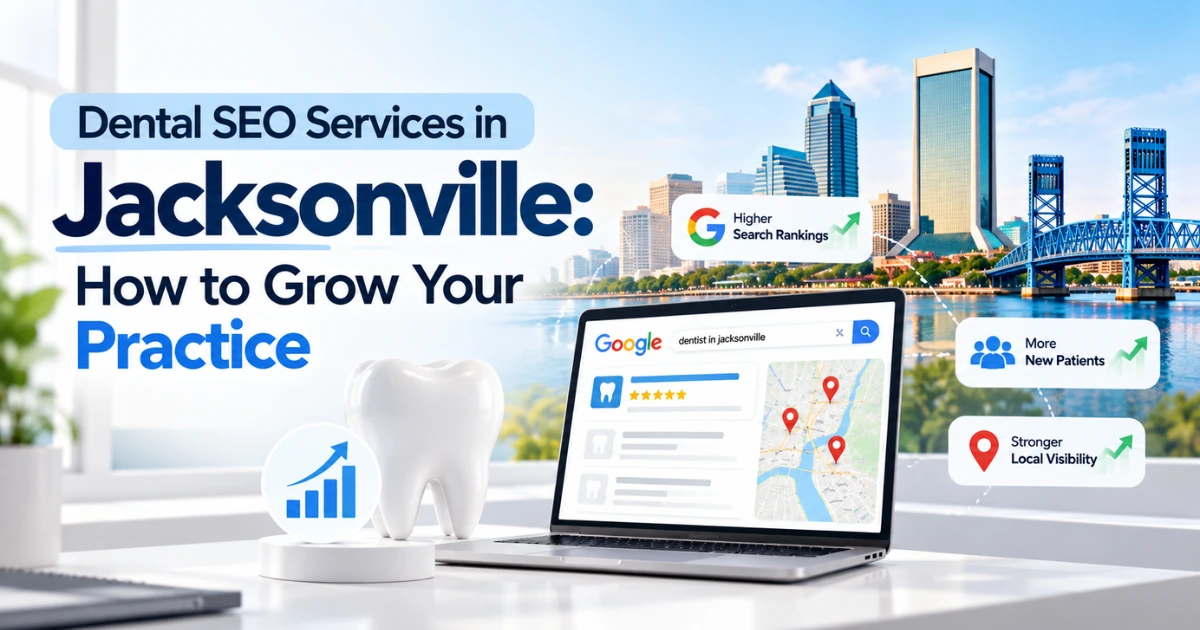
Dental SEO services in Jacksonville exist to solve one problem. When someone types “emergency dentist open Saturday near San Marco,” your practice needs to be one of the first names they see.
Most practices I talk with have a decent website and a few good reviews. The phone still doesn’t ring like it should.
The gap is usually focus, not effort. Many practices spread time across ten tactics when three or four would move the needle.
This guide covers what a good provider does, how Jacksonville patients search, and how to tell real work from a report full of impressions. I work with healthcare and professional-service businesses on local search, and you can read more about me here.
Key Takeaways
- Dental SEO services in Jacksonville should cover your Google Business Profile, service pages, reviews, citations, and technical health, all tied to calls and booked appointments.
- Your Google Business Profile is usually the fastest, highest-impact fix.
- Expect months, not weeks. Results depend on your competition, your website, and your budget.
- Judge a provider by tracking and clear deliverables, never by promised rankings.
- Check review replies, ads, and website claims with your compliance advisor before publishing.
What Dental SEO Services in Jacksonville Actually Include
A complete package covers six areas: your Google Business Profile, service pages, reviews, citations and links, technical health, and reporting. If a provider only does one or two, you’re buying a partial job.
| Area | What it looks like in practice |
| Google Business Profile | Categories, services, photos, posts, Q&A, accurate hours |
| Website content | One strong page per service, plus location context |
| Reviews | A steady, ethical request process and compliant replies |
| Citations and links | Consistent listings and a few quality local mentions |
| Technical health | Fast mobile pages, clean structure, schema, easy booking |
| Reporting | Calls, form fills, and booked appointments, not vanity metrics |
Dentist SEO in Jacksonville vs. generic SEO
Dental searches are local, urgent, and often tied to insurance. Generic SEO tactics, like chasing blog traffic from across the country, rarely bring in patients who can actually sit in your chair.
For a wider look at the basics, see our guide to local SEO for small business. If you want the full picture of what we offer, our SEO services page lays it out.
Why Jacksonville Is Its Own Local Search Market
Jacksonville patients search by area, by insurance, and by urgency. Duval County is spread out, so someone in Mandarin often won’t drive to Jacksonville Beach for a cleaning.
That means your practice competes differently depending on where you sit. A Riverside/Avondale office faces different rivals than one in Southside, Arlington, or Orange Park.
How Jacksonville patients actually search
These are the patterns I’d expect to see in your data:
- “Dentist near me” and “dentist [neighborhood],” such as San Marco, Mandarin, or Ponte Vedra
- “Emergency dentist open Saturday” or “dentist open late”
- “Dentist that accepts [insurance name]”
- “Invisalign Jacksonville” or “dental implants Jacksonville FL”
Local factors worth planning around
With naval installations in the area, many practices see military families. Those patients often search by insurance first.
Back-to-school and year-end benefit deadlines tend to create seasonal bumps. I’m describing patterns I’d test in your own data, not citing statistics. If you want numbers, pull them from your Google Search Console and Business Profile insights.
The local pack, the map results at the top of Google, is crowded in Jacksonville. Winning it takes more than a good website.
Google Business Profile: The Highest-Impact Fix
For most dental practices, your Google Business Profile is the single biggest lever for Dental SEO Services in Jacksonville. It drives the map listing, the calls, and the “directions” taps.
Here’s what I’d check first:
- Primary category: “Dentist” for most general practices. Add secondary categories like cosmetic or emergency dentist only if you truly offer those services.
- Services: List every service with a short, plain description.
- Hours: Keep them exact, including holiday and Saturday hours. Wrong hours cost you emergency calls.
- Photos: Real photos of your team, front desk, parking, and treatment rooms beat stock images.
- Posts and Q&A: Post offers or updates regularly, and seed the Q&A with real questions patients ask.
- Booking link: Point it to a page that actually loads fast on a phone.
One mistake here is common. Practices claim the profile once and never touch it again.
Service Pages and Location Content That Convert
Each major service deserves its own page, written for the patient who’s about to book. A single “Services” page with bullet points won’t rank for implants, Invisalign, or emergency care.
Build separate pages for implants, Invisalign, emergency dentistry, pediatric care, and cosmetic work, if you offer them. Each page should answer:
- What is the treatment, in plain language?
- Who is it for, and what does the process look like?
- What about insurance, financing, and cost ranges, where you can share them?
- How do I book?
Add location context where it’s true. Mention the neighborhoods you serve, nearby landmarks, and parking. Don’t clone one page across ten neighborhoods. Google reads that as thin content.
If writing these pages is a bottleneck, our content writing services can help.
A soft next step
If you’d like a second set of eyes on your profile and service pages, you can book a free consultation with me. No pressure, and no promises about rankings.
Reviews and Reputation
Reviews influence both rankings and whether a patient picks you over the next listing. Volume, recency, and your replies all matter.
Asking ethically
Ask every happy patient, ideally right after the visit, with a direct link. Don’t offer rewards for reviews, and don’t screen who you ask. Google’s policies discourage review gating.
HIPAA-safe replies
Never confirm that someone is a patient, and never mention treatment details. A safe reply thanks them and invites them to call.
Example: “Thanks for the feedback. We take every comment seriously. Please call our office so we can talk.”
Florida dental advertising rules and ADA guidance can affect how you respond and what you say publicly. Verify wording with your compliance advisor. I’m not giving legal advice.
Local Citations, Links, and Authority
Consistent listings and a few good local links reinforce trust. Your name, address, and phone number should match everywhere, from Google to Apple Maps to insurance directories.
Practical link sources include:
- Your local dental society and professional memberships
- Chamber of commerce and neighborhood business groups
- Local school, sports, or charity sponsorships
- Insurance provider directories
Quality beats volume. Ten relevant local mentions are worth more than a hundred spammy directories.
For healthcare-specific tactics, see our guide to local SEO for doctors. We’ve also written a Florida dental resource: local SEO for dentists in Tampa.
Technical SEO Basics for Dental Sites
A slow, clunky site loses patients before they ever read your page. Most dental searches happen on phones, often in a hurry.
Check these basics:
- Speed: Compress images and avoid heavy sliders.
- Mobile layout: Tap-to-call buttons and readable text.
- Booking flow: Fewer fields, fewer steps. Test it yourself on your phone.
- Structure: Clean URLs, one H1 per page, and no broken links.
- Schema: Dentist and FAQ markup help search engines and AI tools understand your practice.
Mistakes I See Often
The most common mistake is measuring rankings instead of patients. I’ve seen practices celebrate a keyword moving up while calls stayed flat.
Other repeat mistakes:
- A Google Business Profile with outdated hours
- One generic “Services” page instead of dedicated service pages
- Replying to reviews with patient details
- A booking form that breaks on mobile
- Hiring on price alone, then getting no reporting
None of these is expensive to fix. They just need someone paying attention.
How to Evaluate Dental SEO Services in Jacksonville
A good provider explains what they’ll do, how they’ll track it, and what could slow results. If the pitch is mostly promises, walk away.
Questions to ask
- What exactly will you do in the first 90 days?
- How do you track calls, form fills, and booked appointments?
- Will I own my Google Business Profile, analytics, and website?
- How do you handle compliance with Florida dental advertising rules?
- Can I talk to a current client in a similar market?
Red flags
- Guaranteed #1 rankings
- Secret methods they won’t explain
- Contracts that lock you in with no reporting
- Fake or purchased reviews
Realistic timelines
SEO usually takes months. Profile fixes can show movement sooner, while content and links build slowly. Competition, your site’s condition, and your budget all shape the pace.
What to track
Use call tracking, form submissions, and booked appointments from the front desk. Ask the team to note how each new patient found you.
Your First 30 Days
Here’s what I’d do first, in order. It’s practical, and it doesn’t need a big budget.
Week 1: Audit your Google Business Profile and fix categories, hours, and services. Set up call tracking and confirm Google Analytics and Search Console are working.
Week 2: Review your top service pages. Rewrite the thinnest one, usually implants or emergency care, with real detail and a clear booking path.
Week 3: Start a review request routine. Draft three HIPAA-safe reply templates and have your compliance advisor look them over.
Week 4: Clean up citations, test your mobile booking flow, and add Dentist and FAQ schema. Then review the first month’s calls and form fills.
Dental SEO vs Paid Ads
SEO builds lasting visibility. Paid ads bring faster traffic but stop when the budget does. Many practices use both.
Ads suit urgent needs, like launching a new service. SEO suits steady, lower-cost patient flow over time. We break down the trade-offs in Google Ads vs SEO, and our Google Ads services page covers the paid side.
Ready to Talk About Your Practice?
If you want more new patients from Jacksonville searches, book a free consultation with Dhiren. We’ll look at your profile, site, and competition, and I’ll tell you what I’d fix first. No hype, and no guaranteed rankings.
How much do dental SEO services in Jacksonville cost?
It varies with competition, scope, and how much work your site needs. Be wary of very cheap packages with no reporting. Ask for a written scope and what’s included each month before you commit.
How long does dental SEO take to work?
Usually several months. Google Business Profile fixes can help sooner, while service pages and links take longer. Competition and your starting point matter. Be skeptical of anyone promising quick, guaranteed rankings.
Should I hire an agency or handle SEO in-house?
If someone on your team has the time and skills, basic tasks like reviews and profile updates work in-house. An agency helps with content, links, and technical work. Many practices split the load.
How important is my Google Business Profile?
Very. It drives the map results, calls, and directions. Keep categories, services, hours, and photos accurate, and respond to reviews consistently.
How do I get more reviews without breaking rules?
Ask every patient after their visit with a direct link, and don’t offer rewards. Reply without revealing patient information. Verify your process with your compliance advisor.
How do I measure the ROI of dental SEO?
Track calls, form fills, and booked appointments, then ask new patients how they found you. Compare against your average patient value. Rankings alone don’t prove ROI.