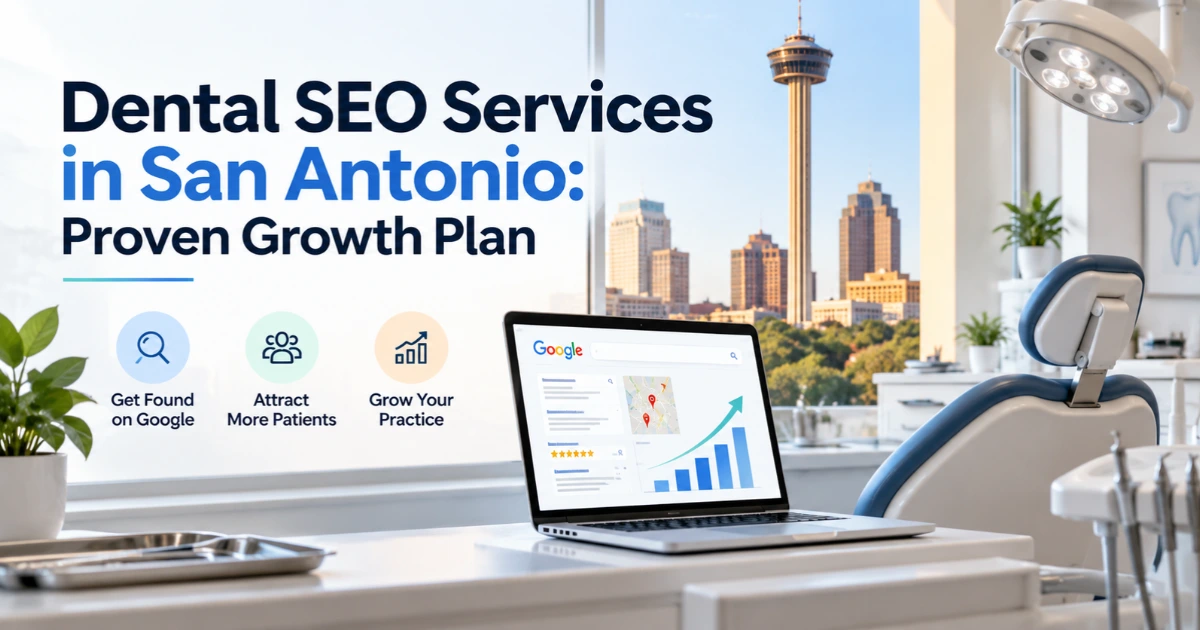
Dental SEO Services in San Antonio come down to one question: when a patient searches for a dentist near them, does your practice show up? If the answer is no, a competitor three miles away is getting that call instead.
This guide is written for practice owners, orthodontists, and office managers who want a clear plan. No vague theory. You will see what actually moves rankings in Bexar County, what wastes budget, and how to judge any agency or freelancer you talk to.
Why Dental SEO Services in San Antonio Matter Right Now
Patients almost always start with a search. They type “dentist near me,” “emergency dentist San Antonio,” or “Invisalign Stone Oak,” then pick from what Google shows first. Most never scroll past the map results and the first few organic listings.
That makes local visibility a patient acquisition channel, not a branding exercise. Strong Dental SEO Services in San Antonio send high-intent patients to your site and phone without paying for every click.
Here is what separates practices that grow from practices that stall:
- They rank in the Google Map Pack for their core neighborhoods.
- They have a fast, mobile-friendly website built around services, not just a homepage.
- They collect reviews consistently, not in a rush once a year.
- They track calls and booked appointments, not just traffic.
If your marketing has felt like guesswork, local dentist SEO in San Antonio replaces guesswork with a repeatable system.
Understand the San Antonio Dental Market
San Antonio is not one market. It is a collection of neighborhoods with different patients, different competition, and different search behavior.
Stone Oak and the north side draw families, professionals, and plenty of cosmetic demand. Practices there compete hard on Invisalign, veneers, and teeth whitening. Alamo Heights and Olmos Park lean toward established, referral-heavy practices that still need strong online reviews to hold their position.
The Medical Center area is crowded with healthcare providers. Dentists there fight for visibility against large groups and specialists. Southtown, Westover Hills, Helotes, and the far west side each have their own rhythm, and military families connected to the area’s bases often search differently than long-term residents.
There is also language to consider. Many San Antonio households search in Spanish or switch between languages. A practice that serves Spanish-speaking patients should say so clearly on its site and profile.
Key takeaway: Effective Dental SEO Services in San Antonio target specific neighborhoods and procedures, not the entire city at once.
Build a Google Business Profile That Wins the Map Pack
Your Google Business Profile (GBP) is often your most important local search asset. For many patients, it is the first thing they see and the only thing they read before calling.
Google Maps ranking for dentists in Texas depends on three broad factors: relevance, distance, and prominence. You cannot change where your office sits, but you can strengthen the other two.
Start with the basics and get them exactly right:
- Primary category: Choose “Dentist” or the most accurate specialty, such as “Orthodontist” or “Pediatric dentist.”
- Secondary categories: Add cosmetic dentistry, emergency dental service, or teeth whitening service if they apply.
- Name, address, and phone (NAP): Match your website and every directory character for character.
- Hours: Include accurate holiday hours and any same-day or weekend availability.
- Services: List every procedure you offer, with short, plain descriptions.
- Photos: Upload real images of your team, your office, and your treatment rooms. Stock photos hurt trust.
Then keep the profile active. Post updates, answer questions, and respond to every review. An abandoned profile signals a practice that does not pay attention.
One warning: never stuff keywords into your business name. Google suspends profiles for this, and recovering one can take weeks. If you want help with a full audit, our SEO services cover profile optimization as part of a broader local plan.
Capture Emergency Dental Searches
Emergency searches are the most valuable traffic a dental practice can win. Someone with a broken tooth or severe pain is not comparing five websites. They call the first office that looks credible and available.
If your practice offers same-day care, build your presence around that fact. Create a dedicated emergency dentist page that covers what you treat, your hours, how fast patients can be seen, and a click-to-call button at the top.
A strong emergency page includes:
- A clear headline with the service and city, such as “Emergency Dentist in San Antonio, TX.”
- Your phone number, tappable on mobile and visible without scrolling.
- Common situations: chipped teeth, knocked-out teeth, abscesses, lost crowns, severe toothaches.
- What to do before arriving, written in simple language.
- Directions and parking details for stressed, in-a-hurry patients.
Also make sure your GBP lists emergency services and accurate hours. Patients searching at 9 p.m. need to see whether you are open, and a wrong answer costs you the appointment.
This is one area where strong Dental SEO Services in San Antonio pay off quickly, because the intent is immediate and the competition often ignores it.
Dental Website Optimization That Turns Clicks Into Appointments
Rankings bring visitors. Your website decides whether they book. Dental website optimization covers both sides: helping Google understand your pages and helping patients take action.
Speed and mobile experience come first. Most dental searches happen on phones, often while the patient is multitasking. A slow page or a tiny phone number loses them in seconds.
Check these technical and structural basics:
- Page speed: Compress images, limit heavy scripts, and test regularly.
- Mobile layout: Buttons should be easy to tap, and forms should be short.
- Clean URLs and headings: Use a logical structure so search engines can read your pages.
- Secure connection (HTTPS): This is the minimum standard now.
- Schema markup: Add local business and dentist structured data so Google can read your details.
- Online booking or a clear request form: Remove steps between interest and appointment.
If your current site is outdated or built on a template that cannot be improved, a rebuild may be the cleaner option. Our web development services focus on fast, search-friendly sites that make booking simple.
Trust matters as much as speed. Show real doctors, real credentials, real patient feedback, and clear pricing information where you can, including insurance and financing options.
Service Pages and Content That Rank
Most dental websites rely on one “Services” page that lists everything in a paragraph. That approach almost never ranks. Google rewards depth, and patients want specifics.
Give each major service its own page. Think dental implants, Invisalign, teeth whitening, root canals, pediatric dentistry, dentures, and emergency care. Each page should answer the questions a nervous patient actually asks.
A solid service page covers:
- What the procedure involves, in plain language.
- Who it suits, and who it may not.
- What recovery or aftercare looks like.
- Cost ranges or what affects the price, plus insurance and payment options.
- Before-and-after examples, with patient permission.
- A short FAQ and a clear next step.
Then build local relevance without forcing it. Mention the neighborhoods you serve, nearby landmarks, and the communities your patients come from. A line about serving families from Stone Oak or Alamo Heights reads naturally and tells Google where you operate.
Blog content supports this work. Articles that answer real patient questions, like what to do about a cracked tooth or how long Invisalign takes, build topical authority and bring in early-stage searchers. If writing is not your strength, professional content writing services can keep your site fresh without pulling you away from patients.
For a deeper look at how local search works for healthcare providers, read our guide on local SEO for doctors.
Reviews and Reputation Signals
Reviews influence both rankings and decisions. A practice with steady, recent, detailed reviews tends to outperform one with a handful of old five-star ratings.
Build a simple process instead of hoping patients remember. Send a review request by text or email after a positive visit, with a direct link to your profile. Train front-desk staff to mention it at checkout.
Follow these habits:
- Ask every happy patient, not just a select few.
- Respond to every review, positive or negative, within a few days.
- Stay professional with criticism. Never reveal patient details, and keep HIPAA in mind in every reply.
- Never buy or fake reviews. Google can remove them, and patients notice patterns.
Reviews that mention specific services and neighborhoods also help relevance. You cannot script that, but you can encourage patients to describe their visit in their own words.
Citations, Links, and Local Authority
Citations are mentions of your practice name, address, and phone number across the web. Inconsistent details confuse search engines and weaken trust, so audit them early.
Focus on quality over volume. Priorities include major data aggregators, health directories, insurance provider directories, and your local chamber of commerce. Fix duplicates and outdated listings before building new ones.
Backlinks matter too, and local ones carry real weight. Sponsor a school event, partner with a nearby orthodontist or oral surgeon for referrals, join community organizations, or contribute dental tips to local publications. These links come from real relationships, which is why they work.
Skip link packages sold in bulk. They are cheap for a reason, and they can put your site at risk.
For a broader look at how neighborhood-level visibility works, see our breakdown of local SEO for small business.
Dental SEO vs. Google Ads
Many practice owners ask whether they should choose SEO or paid ads. The honest answer is that they do different jobs.
Google Ads can generate calls within days. You pay for every click, though, and the leads stop when the budget stops. SEO takes longer to build but compounds over time, lowering your cost per new patient.
A balanced approach often works best:
- Use paid search to fill gaps while organic rankings grow, or to promote high-value services like implants.
- Use SEO as the long-term foundation for steady, lower-cost patient flow.
We compare both in detail in Google Ads vs. SEO, and our Google Ads services can run alongside an organic plan when it makes sense.
How to Choose Dental SEO Services in San Antonio
Not every provider understands dental marketing. Some treat a dental practice like any other website. That gap shows up in the results.
Ask these questions before you sign anything:
- Do you have experience with dental or healthcare clients? Ask to see examples in the portfolio.
- How do you measure success? Look for tracked calls, form fills, and booked appointments, not just rankings.
- Who does the work? Know whether you are dealing with a specialist or a handoff chain.
- What does the first 90 days look like? You should hear about audits, fixes, and content, not vague promises.
- Will I own my accounts and data? The answer must be yes.
Watch for red flags too. Guaranteed first-page rankings, long contracts with no exit, secret methods, and no reporting are all reasons to walk away.
If you want to see how the same approach works in other Texas and U.S. markets, our guide to SEO services for dentists in Austin shows the same principles applied to a different local landscape. You can also browse the full services hub to see how SEO fits with other channels.
How Long Dental SEO Takes
SEO is not instant, and anyone who says otherwise is selling something. Technical fixes and profile improvements can show movement within weeks. Competitive terms, especially in busy areas like Stone Oak or the Medical Center, usually take several months of consistent work.
Several things affect the timeline: the age and quality of your website, your current review profile, the competition in your neighborhood, and how many services you want to rank for.
A healthy pattern looks like this:
- Month one: Audit, fixes, and profile cleanup.
- Months two to three: New service pages, review system, and citation corrections.
- Months four and beyond: Content growth, link building, and refinement based on call and booking data.
Track the numbers that matter: calls from Google, direction requests, form submissions, and new patient appointments. Rankings are useful, but booked patients pay the bills.
About the Author and Next Steps
I’m Dhiren. I’ve spent over a decade helping businesses across Business/Professional Services, Food & Hospitality, Beauty & Wellness, Real Estate & Home, Automotive, Home Services, Legal Services, Healthcare & Medical, and professional services improve their online visibility and attract more customers.
Dental practices are one of the clearest examples of how local search drives real growth. The practices that treat their online presence as part of patient care are the ones whose schedules stay full. You can learn more about my background on the About Us page.
If you want a straight assessment of where your practice stands, book a consultation, and we will review your Google Business Profile, website, and local competition together. Prefer to ask a question first? Reach out through the contact page, or start at the Client Destination homepage to see how we work.
Great Dental SEO Services in San Antonio do not rely on tricks. They rely on accurate profiles, useful pages, real reviews, and steady follow-through. Start with one improvement this week, and build from there.
FAQs
How much do Dental SEO Services in San Antonio cost?
Pricing depends on your competition, your website’s condition, and how many services and locations you want to rank. A single-office practice in a quieter area needs less than a multi-location group in Stone Oak or the Medical Center. Ask any provider for a written scope that spells out deliverables, so you can compare offers fairly.
How long before I see new patients from SEO?
Profile fixes and technical cleanup can show movement within a few weeks. Steady growth in calls and bookings usually builds over three to six months, and competitive procedures like implants or Invisalign can take longer. Judge progress by calls and appointments, not rankings alone.
Can I do dental SEO myself?
Yes, to a point. You can claim and complete your Google Business Profile, ask patients for reviews, and fix your listings. Technical SEO, content planning, and link building take time and specialist knowledge, which is where most busy practice owners hand off the work.
Is a Google Business Profile enough on its own?
No. It drives map visibility and calls, but your website supports it with service pages, trust signals, and booking options. The two work together: a strong profile without a strong site loses patients after the click.
Should I focus on one neighborhood or all of San Antonio?
Start with the areas where your best patients live and work, then expand. Targeting Stone Oak, Alamo Heights, or your immediate zip codes first gives you a realistic path to the top results. Trying to rank citywide on day one spreads your effort too thin.
Do online reviews really affect dental SEO?
Yes. Review quantity, recency, and content influence both your map rankings and a patient’s decision to call. Ask every satisfied patient, reply to each review, and never reveal patient details in your responses.
What is the difference between a dental SEO agency and a freelancer?
Agencies offer larger teams and more services under one roof. A freelancer typically gives you direct access to the person doing the work and often a more flexible setup. Read more in our guide to hiring a freelance SEO expert to decide which fits your practice.
Do I still need SEO if I run Google Ads?
In most cases, yes. Ads stop producing leads when the budget stops, while organic rankings keep working. Using both gives you immediate leads and a lower long-term cost per patient.