It’s 9 p.m. A parent in Broken Arrow has a kid with a swollen cheek, and she grabs her phone and types “dentist near me.” She isn’t going to scroll to page two. She’ll look at the three listings on the map, maybe the first couple of organic results, and call whichever office looks closest, open, and trustworthy.
If your practice isn’t one of those listings, that patient never knew you existed. That’s the problem dental SEO services in Tulsa are meant to solve.
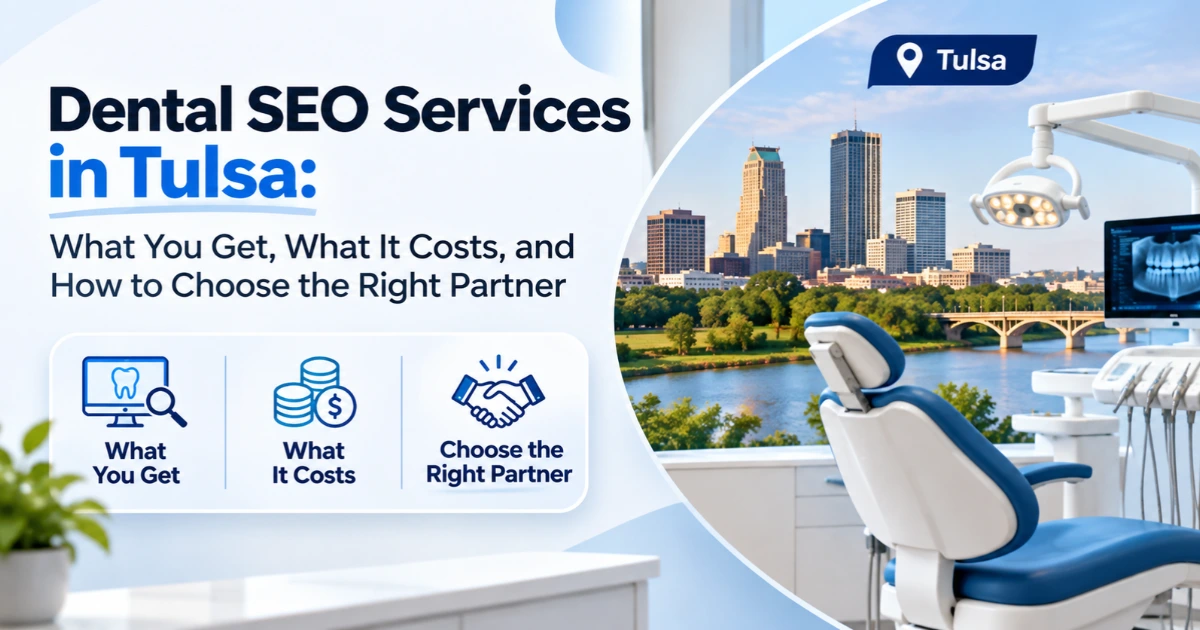
This guide explains what dental SEO actually involves, how the Tulsa market behaves differently from other cities, what it costs, how long it takes, and how to tell a good agency from one that’s mostly selling confidence. Whether you’re hiring help or doing some of it yourself, you should finish this with a clear plan.
What Are Dental SEO Services in Tulsa?
Dental SEO services in Tulsa are the ongoing work of making a dental practice easier to find in Google Search and Google Maps for people in the Tulsa area who are looking for care. That work covers your Google Business Profile, your website’s pages and technical health, your reviews, your local listings and links, and the content that answers patients’ questions.
The goal isn’t rankings for their own sake. It’s phone calls, form fills, and booked new-patient appointments from people who live or work close enough to actually come in.
Why Tulsa Dental SEO Isn’t Like Dental SEO Anywhere Else
A lot of the advice floating around is written for “dentists in [your city]” and could be swapped between Tulsa, Tampa, and Tacoma without anyone noticing. Tulsa has its own quirks, and they matter.
It’s a spread-out metro with real neighborhood identities. The Tulsa area is home to roughly 1.1 million people, and it’s laid out on a mile grid that people actually use to give directions. Someone living near 71st and Memorial and someone in Owasso may both say they’re “in Tulsa,” but they’re not competing for the same dentist. Midtown and Brookside, Downtown and the Pearl District, South Tulsa, Jenks, Bixby, Broken Arrow, Owasso, Sand Springs, Sapulpa, and Claremore each behave like their own small market.
Google cares about distance, a lot. Google’s own documentation says local results are based mainly on three things: relevance, distance, and prominence. You can’t move your office, but you can make sure Google clearly understands where you are, who you serve, and that your practice is well known and well reviewed.
Insurance is the first question. Patients here are asking about employer plans, Medicare Advantage dental benefits, SoonerCare for their kids, and in some households, tribal health benefits. Practices that say plainly what they accept tend to win the call over practices that make people hunt for it.
Weather matters more than you’d think. Ice storms and spring severe weather close offices a few times a year. A Business Profile that still says “Open” when you’re shut is a quick way to collect one-star reviews.
What Good Dental SEO Services in Tulsa Actually Include
Here’s what a solid engagement should cover. If a proposal skips several of these, ask why.
1. Google Business Profile optimization
For most practices, this is where the most patient calls come from, especially for “near me” searches. A properly built profile has the right primary category (usually “Dentist,” with secondary categories only where they’re accurate), a complete services list, hours that match your website exactly, real photos of your building, team, and treatment rooms, and your insurance and accessibility details filled in.
It also means posting updates, answering the Q&A section, and keeping holiday and weather-related hours current. If you have more than one office, each one needs its own profile, its own phone number, and its own page on your site.
2. Location pages and service pages that match how people search
Your homepage can’t do everything. A practice in Jenks that also does implants needs a page for the Jenks office and a dedicated page for dental implants, each with its own purpose.
A strong location page names the suburb or neighborhood, lists the address and the nearest cross streets (people really do search “dentist near 101st and Yale”), shows hours and parking, lists accepted insurance, and includes a map and a way to book. Thin pages that just swap the city name in and out don’t work, and Google has gotten better at spotting them.
3. On-page SEO and technical health
This is the plumbing. Page titles and headings that say what each page is about. Fast load times, especially on a phone with a weak signal. A mobile layout that doesn’t make people pinch and zoom. Clean site structure, working internal links, no broken pages, and schema markup so Google can read your name, address, services, and reviews without guessing.
4. Review generation and reputation management
Google states that review count and review score factor into local ranking. So it’s not just about having a handful of five-star reviews from 2022. It’s about a steady flow of fresh ones, from the right office, with real responses from your team.
The simplest system that works: send a review link by text after each visit, ask everyone (not just the patients you think are happy), and reply to every review. Which brings up a compliance point we’ll get to below.
5. Local citations and local links
Your name, address, and phone number should read the same everywhere: your website, Google, Apple Maps, Yelp, Healthgrades, insurance directories, and the Oklahoma Dental Association’s directory if you’re a member. Inconsistencies confuse search engines.
Links matter too. The ones worth having are local and real: a chamber of commerce membership, a school or youth sports sponsorship, a charity event you actually supported, or a feature in a Tulsa publication. Be wary of anyone selling bulk links.
6. Content that answers real patient questions
Patients search for answers before they search for dentists. “How much do dental implants cost?” “Is Invisalign worth it for adults?” “What happens at an emergency dental visit?” Good content answers those questions honestly, written or reviewed by the dentist, and points readers to the next step.
7. Tracking and reporting that tie back to patients
Rankings are nice. Calls are better. Your reporting should show phone calls (with call tracking), form submissions, direction requests and clicks from your Business Profile, organic traffic, and ideally, how many of those became booked appointments. If the monthly report is mostly keyword position screenshots, push back.
What Tulsa Patients Search For (and the Page That Should Answer It)
Here’s a sample of how search intent maps to pages. Use it as a starting point for your own keyword plan.
| What the patient types | What they want | Page that should rank |
|---|---|---|
| dentist near me / dentist Tulsa | A nearby office, right now | Google Business Profile + location page |
| dentist in Jenks / Broken Arrow dentist | A dentist in their own town | Suburb-specific location page |
| emergency dentist Tulsa | Same-day help | Emergency dental page, with hours and phone up top |
| dental implants Tulsa | A procedure and a price range | Dedicated implants service page |
| Invisalign Tulsa / orthodontist Tulsa | Options and consultation | Service page with FAQs |
| pediatric dentist Tulsa | A kid-friendly office | Pediatric page with team and insurance info |
| dentist that accepts SoonerCare Tulsa | Coverage confirmation | Insurance page, linked from each location |
| teeth whitening Tulsa | Price and results | Cosmetic service page with before/after (with consent) |
Notice the pattern: every search has a different intent, so every intent deserves its own page. One long “Services” page trying to cover all of them rarely ranks for any.
How Much Do Dental SEO Services in Tulsa Cost?
There’s no single price, and anyone quoting one without looking at your situation is guessing. Monthly retainers for dental SEO typically range from several hundred dollars for a very limited scope to a few thousand for multi-location practices in competitive areas. What moves the number:
- Competition in your part of the metro. A busy stretch of Yale or Memorial is a tougher fight than a smaller town.
- Number of locations. Each office needs its own profile and page.
- Starting point. A site with technical problems and no reviews needs more work than one that’s already in decent shape.
- Scope. Is content writing included? Link building? Review management? Call tracking?
- Your goals. Wanting more implant and cosmetic cases is a different campaign from filling hygiene schedules.
Instead of comparing prices, compare scope. Two quotes at the same number can include completely different amounts of work. Ask for a written list of deliverables.
How Long Does Dental SEO Take to Work?
Plan on three to six months to see steady movement, and longer for a broad term like “dentist Tulsa.” That’s a general rule, not a promise. Specific searches (say, “implants in Bixby”) often respond sooner than broad ones, because there’s less competition and Google has a clearer sense of who the best local match is.
SEO also compounds. The first couple of months are mostly fixing and building. If someone promises page-one results in 30 days, they’re either targeting terms nobody searches or they’re not being straight with you.
How to Choose a Dental SEO Company in Tulsa
Ask these questions in the first call:
- Who will be doing the work? Is it the person on the sales call, or is it handed off?
- Will I own my accounts? Your Google Business Profile, Analytics, and Search Console should be in your name, with the agency added as a manager.
- What exactly is in the monthly scope? Get it in writing.
- How do you handle reviews and compliance? Listen for specifics.
- What do you report on? Calls and booked appointments should be on the list.
- Have you worked with dental practices? What did you learn about patient behavior that surprised you?
- What’s the contract length and exit process? Month-to-month or short terms after an initial setup are reasonable. Long lock-ins with penalties are a flag.
Red flags:
- Guaranteed #1 rankings
- Secret or “proprietary” methods they won’t explain
- Cheap links in bulk
- No access given to your own accounts
- Reports that are all impressions and keyword positions
- Copy-pasted location pages with only the suburb name changed
It’s fine, and often smart, to work with an agency that isn’t in Tulsa, as long as they understand how Tulsa patients actually search and don’t treat the metro as one big blob. Ask them to explain the difference between Midtown and Owasso. If they can’t, keep looking.
A Starting Checklist You Can Use This Week
Even if you hire help later, these steps cost little and move the needle:
- Claim and verify your Google Business Profile, and check that your primary category is right
- Make sure your name, address, and phone number match everywhere, character for character
- Add current photos of your actual office and team
- List every service you offer on your profile and on its own website page
- Add the dentist’s name and license type to service pages
- Post your accepted insurance plans in plain language
- Start texting a review link after every appointment, and reply to every review
- Test your site on your phone, on cellular data, not Wi-Fi
- Set up Google Search Console and call tracking so you can see what’s working
- Update your hours the same day when weather closes the office
Common Mistakes Tulsa Practices Make
Treating SEO as a one-time project. Google changes, competitors keep working, and reviews age. It’s ongoing.
Targeting “Tulsa” only. If your office is in Jenks, lead with Jenks. Patients there often search for their own town first.
Ignoring the phone experience. Most local dental searches happen on mobile. If your number isn’t tappable or your booking form asks for twelve fields, you’ll lose people you worked hard to attract.
Chasing rankings instead of patients. A first-place keyword that brings no calls isn’t a win.
Letting the website fall behind. An outdated site with slow pages and old team photos tells patients something, and it isn’t flattering.
Conclusion
Dental SEO services in Tulsa work when they’re built around the way people in this metro actually choose a dentist: by neighborhood, by convenience, by insurance, and by who looks trustworthy on their phone. Get your Google Business Profile right, give each office and service a real page, collect reviews steadily, stay on the right side of the rules, and measure what matters, which is booked patients.
If you’d like a second set of eyes on where your practice stands today, I’m Dhiren, and I offer a free dental SEO review for Tulsa practices. I’ll look at your Google Business Profile, your website, and the competitors showing up ahead of you, and tell you plainly what’s worth fixing first. Get in touch with me here.
Frequently Asked Questions About Dental SEO in Tulsa
What do dental SEO services include?
A complete package usually covers Google Business Profile management, local and service-page optimization, technical SEO, review generation, citation cleanup, content creation, local link building, and reporting on calls and appointments.
How much do dental SEO services cost in Tulsa?
It depends on your competition, number of locations, and scope. Retainers can run from several hundred dollars a month for limited work to a few thousand for larger or multi-location practices. Compare written deliverables, not just prices.
How long does it take to rank in Tulsa?
Most practices see meaningful movement in three to six months. Narrow searches tied to a specific suburb or treatment often move faster than broad ones like “dentist Tulsa.”
Is local SEO different from regular SEO for dentists?
Yes. Regular SEO focuses on ranking pages in standard results. Local SEO focuses on appearing in the map results and “near me” searches, where your Business Profile, reviews, and proximity play a bigger role. Dentists need both.
Do I need a separate page for each Tulsa suburb?
If you have a physical office there, yes: one page per location. If you serve a nearby town without an office, a helpful area page can work, but it shouldn’t read like a copy of your other pages.
Do Google reviews really affect rankings?
Google says review count and score factor into local ranking. Reviews also influence whether a patient picks you once they see your listing, so they work twice.
Does SEO replace Google Ads?
No. Ads can bring patients quickly while you pay for them. SEO builds slower and keeps working after the budget stops. Many practices use both, with ads covering high-value services or gaps while SEO matures.
How do I know it’s working?
Track phone calls, form submissions, Business Profile actions (calls, directions, website clicks), organic traffic, and, most important, new patients booked. Ask your front desk to note where new patients heard about you.